
The Impact of AI on Our Daily Lives: A Look at 2024-2026

Artificial intelligence (AI) is no longer a futuristic concept, but an integral part of our daily lives. From the way we work and learn to how we communicate and relax, AI is transforming our world at a rapid pace.
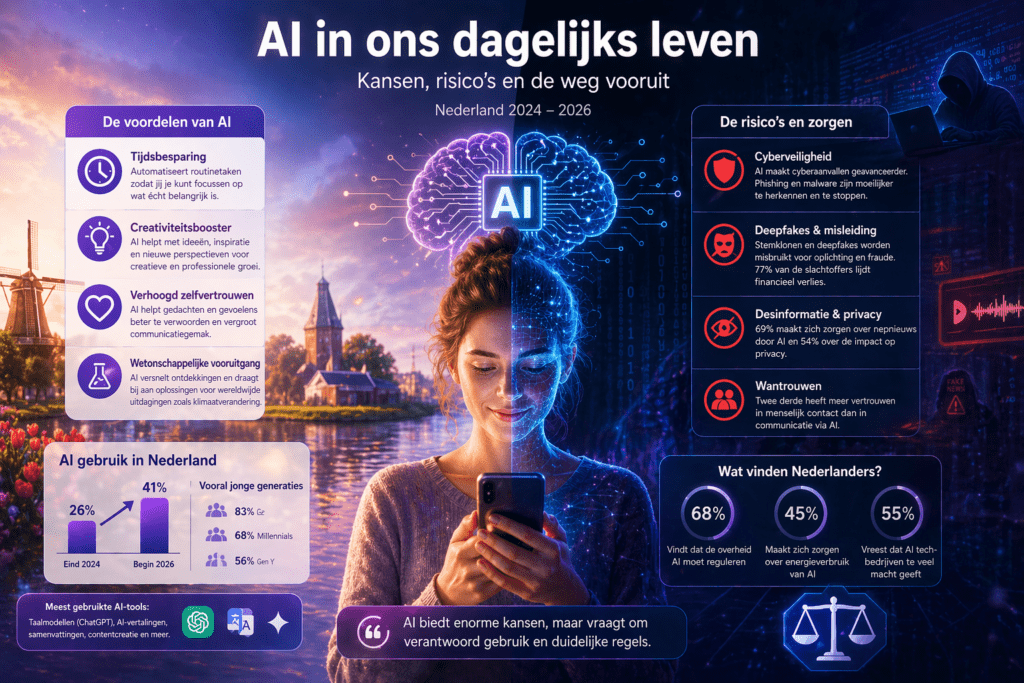
Artificial intelligence (AI) is no longer a futuristic concept, but an integral part of our daily lives. From the way we work and learn to how we communicate and relax, AI is transforming our world at a rapid pace. This article delves into recent developments and the perception of AI in the Netherlands between 2024 and 2026, highlighting both the benefits and the challenges this technology brings.
AI in Practice: Growth and Generational Differences
The use of AI has increased significantly in recent years. In the Netherlands, the percentage of people using AI for work or study has risen from 26% at the end of 2024 to 41% at the beginning of 2026. This growth is primarily driven by younger generations. For instance, 83% of Gen Z and 68% of Millennials regularly use AI. Also striking is the sharp increase among Gen Y (older Millennials), where usage rose from 40% to 56%. The most common applications are language models such as ChatGPT and AI-driven translation services.
The Benefits of AI: Efficiency and Creativity
AI offers various benefits that enrich and simplify our daily lives:
• Time saving: AI tools can automate routine tasks, such as handling emails, summarizing long texts, and scheduling appointments, leaving us more time for more complex or creative activities.
• Creativity booster: For writers, artists, and professionals, AI can serve as a powerful brainstorming tool. AI art and text generators can offer new perspectives and stimulate the creative flow.
• Increased Self-Confidence: Some people use AI to better articulate their thoughts and feelings, for example when writing personal messages. This can help lower communication barriers and boost self-confidence.
• Scientific Advancement: AI accelerates medical discoveries and contributes to solutions for global challenges, such as the development of materials for CO2 capture that are essential in the fight against climate change.
The Dark Side of AI: Risks and Concerns
Despite the many benefits, AI also brings significant risks and ethical dilemmas:
• Cybersecurity: AI makes cybercrime more sophisticated. Thanks to AI, phishing emails are harder to recognize due to flawless grammar and convincing stories. Moreover, AI can accelerate the development of new, hard-to-detect malware.
• Deepfakes and Deception: Deepfake technology and AI voice clones are being misused for scams, such as the so-called 'grandparent scam'. Research shows that 77% of victims of voice clone scams suffer financial loss.
• Disinformation and Privacy: A majority of Dutch people (69%) are concerned about the spread of fake news by AI, and 54% are concerned about the impact of AI on privacy.
• Distrust: Two-thirds of the Dutch indicate having more trust in human contact than in communication via AI, especially among older generations.
Public Opinion and the Call for Regulation
Public opinion on AI is complex. Although usage is increasing, there remains a strong desire for regulation. 68% of Dutch people believe that the government should play an active role in regulating the development and application of AI. Additionally, 45% are concerned about the energy consumption of AI systems, and 55% fear that AI gives tech companies too much power.
Conclusion
AI is a double-edged sword. It offers unprecedented opportunities for efficiency, creativity, and scientific advancement, but simultaneously poses serious risks regarding cybersecurity, deception, and privacy. Society faces the challenge of embracing the benefits of AI while simultaneously developing robust frameworks and regulations to mitigate the risks and maintain public trust. The debate regarding the balance between innovation and ethics will continue unabated in the coming years.
References
[1] AI Barometer shows increased usage, but distrust remains | Netherlands Digital